

Blog
Importing Automotive Chemicals into Panama: The Gateway to Latin America

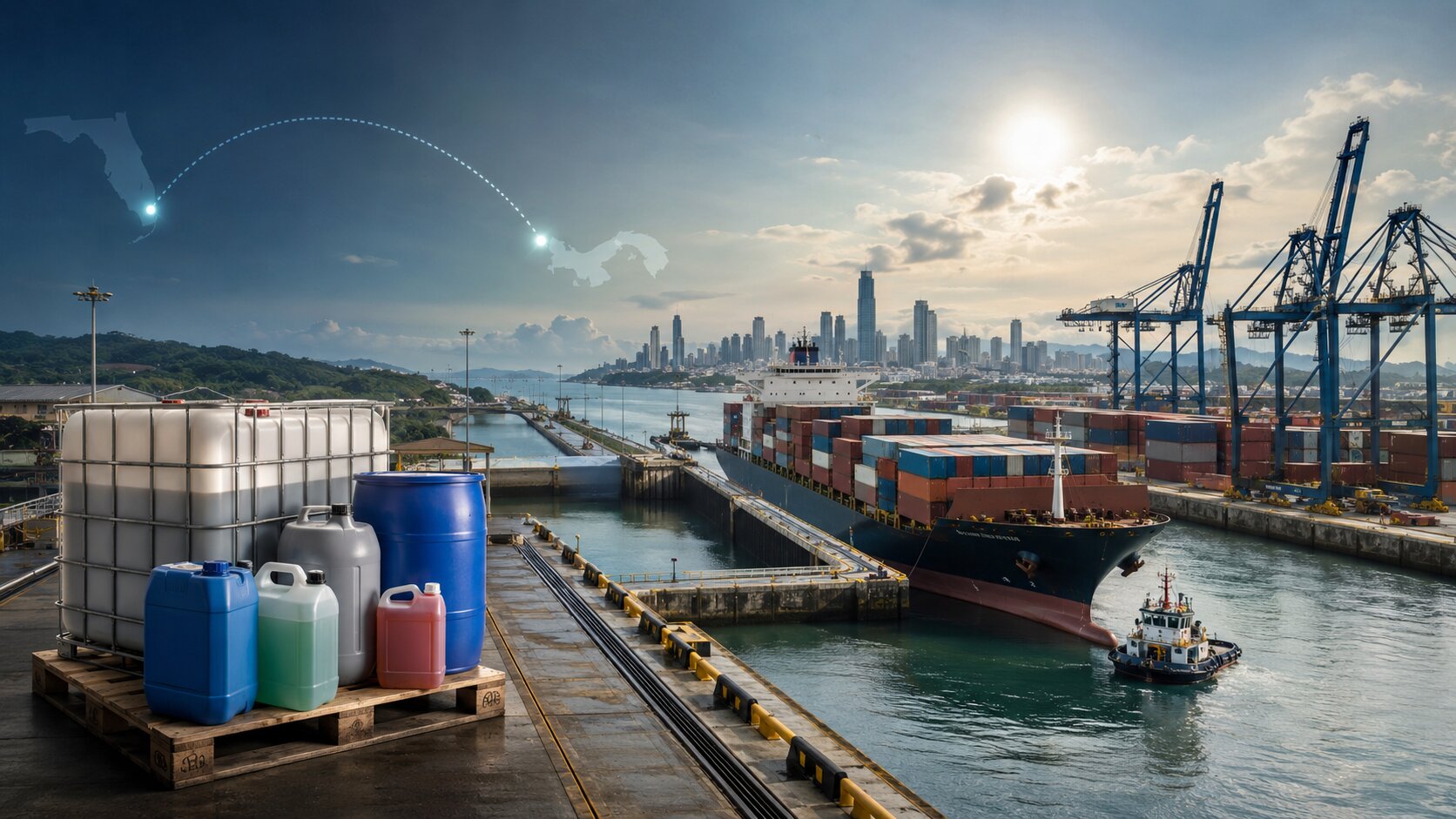
Importing Automotive Chemicals into Panama
The Gateway to Latin America
Panama is not just a market — it is the region's logistics spine. For distributors of antifreeze, coolant and DEF, a single Panamanian inventory point can serve the domestic fleet and re-export across Central America, northern South America and the Caribbean.
Strategic Logistics & Commercial Overview
A high-level synthesis for procurement directors, distributors, and logistics managers evaluating Panama as an automotive chemical import and re-export hub.
2–4 Days
Direct ocean transit from PortMiami to Colon Free Zone; 5–7 days to Balboa / Panama City via the Canal.
0% Duty
US–Panama Trade Promotion Agreement (TPA) grants 0% tariffs on qualifying US-manufactured automotive fluids.
Central & South America
Colon Free Zone serves as the Americas' primary bonded distribution center with complete ITBMS exemption on re-exports.
ASTM & API Spec
US-manufactured coolants, DEF, and fluids compliant with Euro 4/5 fleet standards, available in full container loads.
Key Takeaways
- Dual Market Access: Sourcing through Panama unlocks high domestic demand (driven by trucking and Canal maritime operations) alongside duty-free re-export opportunities.
- Lead Time Optimization: Miami's proximity enables rapid container inventory turnover, lowering working capital requirements compared to Asian or European suppliers.
- Compliance Ready: Standardized documentation (COA, SDS, GSP/TPA Certificate of Origin) streamlines clearance through Panamanian customs and the Colon Free Zone Authority.
Panama occupies a unique position in Latin American trade. More than just a country, it is the region's premier logistics and re-export hub — a strategic location where goods from North America, Europe and Asia converge before being distributed across Central America, South America and the Caribbean.
For distributors and importers of automotive chemicals, Panama represents both a domestic market opportunity and a regional distribution platform. A well-positioned Panamanian importer can supply not only the domestic Panamanian market but also neighboring Central American markets and beyond from a single, strategically located inventory point.
This guide covers the practical aspects of importing US-made automotive chemicals into Panama and using Panama as a regional distribution base.
Panama as a Re-Export Hub
The Colon Free Zone (CFZ), located at the Atlantic entrance to the Panama Canal, is the second-largest free trade zone in the world after Hong Kong. It serves as a major trans-shipment and re-export point for goods destined for Latin American and Caribbean markets.
Importers operating within the CFZ benefit from duty-free importation of goods, simplified customs procedures, and direct access to both Caribbean and Pacific shipping lanes through the Canal.
For automotive chemical distributors with regional ambitions, operating from Panama — either within the CFZ or from the domestic market — provides access to a customer base spanning Central America, northern South America and the Caribbean. Miami to Colon transit times are among the shortest in the region, typically 2 to 4 days, making Panama one of the most logistics-efficient sourcing points in all of Latin America.
- →Duty-free importation of goods
- →Simplified customs procedures
- →Atlantic + Pacific lane access
- →ITBMS exempt on re-export
- →Shortest US transit in the region
The Domestic Panamanian Market
Beyond the re-export opportunity, Panama's domestic automotive market is significant and growing. Panama City has one of the highest vehicle densities in Central America, and the country's heavy dependence on trucking for internal logistics — combined with its role as a Canal transit point — means strong demand for commercial vehicle chemicals including heavy-duty coolant and DEF.
Panama adopted Euro 4 and Euro 5 equivalent emission standards for new commercial vehicles, driving growing demand for DEF among fleet operators, bus companies and heavy equipment operators. Distributors who establish reliable DEF supply relationships now are positioned ahead of continued growth as the vehicle fleet modernizes.
Miami to Panama: Two Gateways
Miami to Panama is one of the most well-served and cost-effective trade lanes in the Americas. Regular container services connect PortMiami to both Colon on the Atlantic side and Balboa on the Pacific side, with multiple weekly sailings.
Miami → Colon
Colon Free Zone
Multiple weekly direct services. Ideal for CFZ operators and re-export distributors serving Central America and the Caribbean from a single bonded inventory point.
Miami → Balboa
Panama City
Routed via Panama Canal transit. Serves the domestic Panamanian market and Pacific-facing distributors supplying Panama City and the interior.
FOB Miami
Incoterm baseline
Standard for Panamanian importers. Your freight forwarder coordinates with PortMiami for loading and handles delivery to your chosen Panamanian port.
Import Duties and the US–Panama TPA
The United States and Panama have a Trade Promotion Agreement (TPA) in effect since 2012. Under this agreement, most finished chemical products from the United States enter Panama at significantly reduced or zero tariff rates when accompanied by a valid Certificate of Origin.
Import Duty
Most automotive chemical categories enter at 0% under the US–Panama TPA with a valid Certificate of Origin. Confirm applicable treatment with your Panamanian customs broker.
ITBMS (VAT Equivalent)
Panama applies ITBMS at 7% to most imported goods. Products entering the Colon Free Zone for re-export are generally exempt from ITBMS.
Required Import Documentation
- 01Commercial Invoice
Full product description and FOB values.
- 02Packing List
Weights, counts and packaging formats per pallet.
- 03Bill of Lading
Carrier-issued transport document for the shipment.
- 04Certificate of Origin
Required to claim TPA tariff treatment.
- 05Safety Data Sheet (SDS)
One SDS for each chemical product shipped.
- 06Certificate of Analysis (COA)
Issued directly by the manufacturer.
- 07CFZ Customs Documentation
For Colon Free Zone imports, additional documentation as required by the Colon Free Zone Authority.
Products with Strongest Demand in Panama
Given Panama's role as a Canal transit and trucking hub, heavy-duty coolant and DEF are among the strongest-demand categories for the domestic market. Commercial vehicles — trucks, buses, construction and port equipment — represent a large share of the vehicle fleet.
For CFZ re-exporters, the full range of automotive chemicals is relevant because they are supplying diverse end markets across Central America and the Caribbean, each with different vehicle fleet compositions and product requirements. Carrying a full line from a single US supplier simplifies procurement and documentation significantly.
American Mfg Co: Your US Source for Panama
American Mfg Co manufactures our complete automotive chemical line — antifreeze, coolant, DEF, windshield washer fluid and degreasers — at our Miami, Florida facility. Our Miami location means 2 to 4 day transit times to Colon, making us one of the fastest and most cost-effective US sources for Panamanian importers and CFZ operators.
All products are 100% Made in the USA, certified to ASTM and API standards, and available by container and truckload. We provide complete export documentation for every order. Private label programs are available across our full product line.